The Untouchables: Lebanon’s Lifers, Fiefdoms, and the Sectarian Architecture of Impunity
The Untouchables Series
Published · Updated
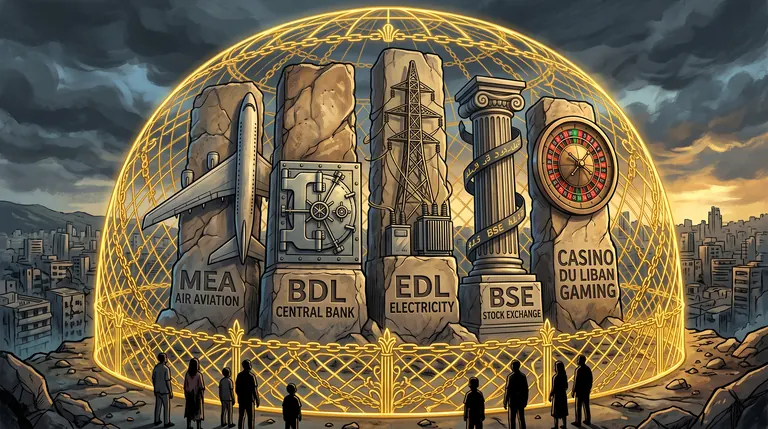
In Lebanon’s meticulously carved-out sectarian mosaic, public office is rarely a matter of public service. Instead, key institutions, regulatory bodies, and state-backed corporations operate as permanent fiefdoms—private estates distributed among the political-sectarian elite as lifetime sinecures.
While governments rise and fall, and the broader population shoulders the burden of economic collapse, a select group of institutional "lifers" remains completely insulated from accountability. They hide behind the shields of sectarian representation, institutional monopoly, and manufactured narratives of national sacrifice.
This dossier expands The Untouchables series across the core pillars of Lebanon’s captured state, revealing how these permanent mandates sustain the ruling class at the expense of the public.
1. The Skies of Monopoly: Mohamad El-Hout (Middle East Airlines)
- The Reign: Directing MEA since 1998, Mohamad El-Hout has turned the national carrier into a masterclass in institutional permanence spanning nearly three decades.
- The Fiefdom Dynamics: Implicitly protected as part of the Sunni political establishment's institutional allotment, El-Hout’s longevity is defended under the guise of community representation.
- The Reality: While public relations campaigns celebrate MEA for keeping operations open during crises, the reality is a captive market. By blocking low-cost international competitors, MEA forces Lebanese expatriates and locals to pay fares 2x to 3x higher than regional averages, monetizing the desperation of a trapped diaspora.
2. The Architect of Ruin: Riad Salameh (Banque du Liban)
- The Reign: For three decades (1993–2023), Riad Salameh ruled Lebanon’s central bank with absolute, unquestioned authority, hailed internationally as a financial wizard while engineering a ticking time bomb.
- The Fiefdom Dynamics: Salameh survived every political shift because every faction in Lebanon’s ruling cartel fed off the liquidity and engineering schemes he provided.
- The Reality: His tenure culminated in one of the worst economic collapses in modern history, wiping out the lifetime savings of millions. Yet, even through domestic and international legal reckonings, his legacy underscores that the higher up the financial pyramid you sit in Lebanon, the deeper your immunity.
3. The King of Darkness: Kamal Hayek (Electricité du Liban)
- The Reign: Directing state-owned Electricité du Liban (EDL) across successive political administrations and collapsing energy grids, Kamal Hayek has maintained his grip on the country’s most notorious budgetary black hole.
- The Fiefdom Dynamics: EDL functions as a prime political spoil, where administrative accountability is replaced by sectarian quota-sharing.
- The Reality: While millions of Lebanese endured decades of near-total darkness and financed a parallel economy dominated by generator cartels, EDL continued to drain billions in public funds with zero transparency or structural reform.
4. The Fossilized Exchange: Fadi Khalaf (Beirut Stock Exchange)
- The Reign: Headed by Fadi Khalaf, the Beirut Stock Exchange operates more like an exclusive, closed-loop club than a functional capitalist market.
- The Fiefdom Dynamics: Board and management seats are treated as generational appointments parceled out through political horse-trading.
- The Reality: In a healthy economy, capital markets drive corporate transparency, liquidity, and growth. In Lebanon, the Bourse functions as a hollow cosmetic facade, maintaining an illusion of normalcy while the productive economy lies in ruins.
5. The House of High Stakes: Charles Ghostine (Casino du Liban)
- The Reign: Following the turbulence and legal controversies of his predecessor Roland Khoury, Charles Ghostine took the helm as Chairman and General Manager of Casino du Liban.
- The Fiefdom Dynamics: Historically backed by a legal gambling monopoly, the Casino has long functioned as a massive patronage mill for political cronies.
- The Reality: Despite sweeping structural crises across the country, this high-stakes cash cow remains heavily insulated by political protection, continuing a tradition where executive faces change at the top, but the culture of impunity remains untouched.
Conclusion: Dismantling the Lifers
Mohamad El-Hout, Riad Salameh, Kamal Hayek, Fadi Khalaf, and Charles Ghostine are not anomalies; they are the structural mortar of the Lebanese sectarian-political cartel. Whether managing the skies, the currency, the power grid, or capital markets, these figures survive every catastrophe because their tenure guarantees the ruling elite a continuous supply of jobs, liquidity, and operational immunity.
Until Lebanon opens its markets to genuine competition, strips away monopolistic privileges, and subjects its corporate "lifers" to transparent public oversight, the state will remain a private extraction machine for the few.