The Canton Divide: Why Christian and Muslim Municipalities Look Like Different Countries
Published · Updated
A Note to Readers:
Discussions surrounding municipal management, infrastructure, and regional disparities in Lebanon often touch on deep communal sensitivities. This article is explicitly not an exercise in sectarian chauvinism, nor does it endorse the reductive premise of cultural or religious superiority. The disparity in municipal upkeep, waste management, and public order across different Lebanese regions is not a measure of moral virtue or inherent community worth. Rather, as this analysis explores, it is the structural, economic, and psychological symptom of a collapsed central state, divergent models of capital deployment, and the breakdown of the public commons.
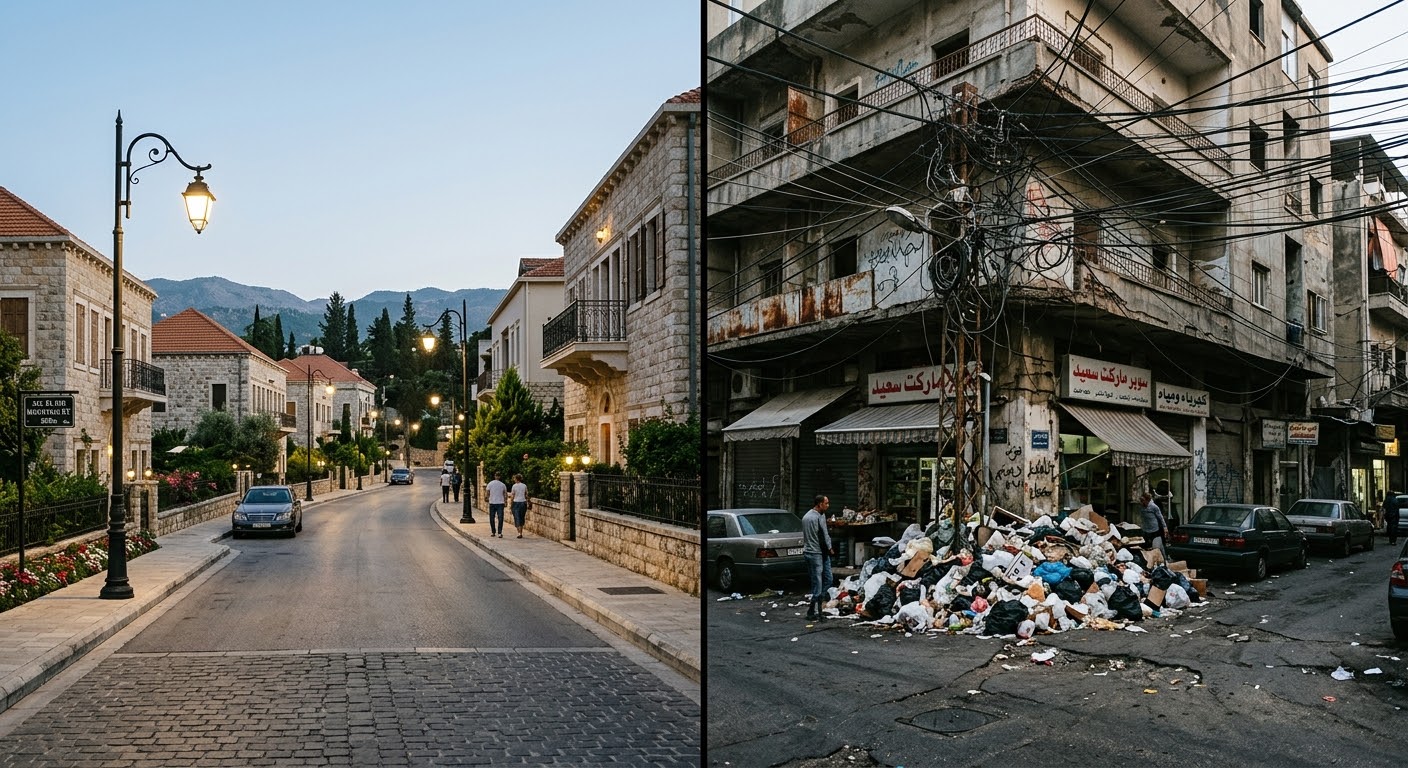
Drive across the municipal boundaries in contemporary Lebanon, and you transition across a quiet, undeniable frontier.
You might leave behind a chaotic, unlit corridor cluttered with overflowing dumpsters, haphazard scaffolding, and roads fractured by craters, only to enter a neighboring town where streetlights function, traffic lights govern intersections, sidewalks are swept, and waste management is meticulously organized. You feel an immediate, profound sense of governance—the phantom sensation that a functioning state actually exists.
This stark geographical divide is one of the most glaring open secrets in modern Lebanon. It is openly discussed in private and increasingly whispered in Muslim circles, yet treated as a profound social taboo in polite public discourse. Why are Christian-majority cities and towns markedly cleaner, better run, and more orderly than their Muslim-majority counterparts?
Stripping away sectarian sensitivities to conduct a deep sociological, economic, and institutional autopsy reveals several underlying structural realities.
1. Capital Deployment vs. Private Survival: The Myth of Simple Remittances
It is a mistake to attribute the municipal divide simply to the presence or absence of money. Massive liquidity exists across multiple sects—including the immense mercantile wealth generated by Shiite diaspora networks across West Africa (Côte d'Ivoire, Nigeria, Senegal) as well as traditional Western remittance pipelines.
Yet, having cash in a community does not automatically translate to clean public streets. The true differentiator is how that capital is governed and deployed:
-
The Independent Municipal Board Model: In many Christian-majority areas, private liquidity and diaspora funds are frequently channeled through localized civic networks, municipal development boards, and property-owning syndicates that prioritize local aesthetic preservation, real estate liquidity, and public infrastructure (streetlights, paving, waste contracts).
-
The Patronage and Private Compound Trap: In regions dominated by strong political parties and centralized patronage networks (such as the South or the southern suburbs of Beirut), vast amounts of incoming capital are absorbed into private family survival, massive residential rebuilding following repeated military conflicts, or party-administered social and military apparatuses. When local governance is subordinate to regional political logistics, municipal budgets are starved, and taxes or donations bypass public infrastructure entirely.
2. Demographic Absorption and the Burden of the Displaced
Another crucial variable is how these different cantons absorbed the regional demographic shocks of the past decades.
-
The Refugee & Migrant Concentration: Following the outbreak of the Syrian civil war in 2011, millions of displaced Syrians—alongside preexisting Palestinian refugee populations—flooded Lebanon. Due to a combination of real estate pricing, historical labor patterns, and political alignment or local municipal policy, these populations concentrated overwhelmingly in specific urban and suburban corridors: the southern suburbs of Beirut, Tripoli, parts of the Beqaa, and Saida.
-
Infrastructure Collapse Under Load: Municipalities in these regions were forced to absorb massive, impoverished populations without a single dollar of international burden-sharing channeled through transparent local infrastructure funds. A municipal sanitation system designed for 20,000 residents collapsing under the weight of 80,000 people—living in informal multi-story concrete structures built without zoning laws—inevitably leads to environmental and civic breakdown.
-
Gated Exclusion: Wealthier Christian municipalities, by contrast, frequently instituted strict informal zoning, nighttime curfews, and municipal police patrols that limited large-scale, unregulated demographic expansion, preserving their physical infrastructure at the cost of intense socio-economic segregation.
3. The Irony of "Cleanliness is Part of Faith" (Al-Nazafa min al-Iman)
A cynical joke frequently echoes over overflowing waste dumps in urban Muslim neighborhoods, pointing ironically to the famous religious maxim displayed in calligraphy or cultural lore: النظافة من الإيمان (Cleanliness is part of faith).
Why does a society that places immense religious emphasis on personal hygiene, ritual purification (wudu), and household cleanliness tolerate catastrophic public squalor?
-
The Public-Private Dichotomy: In many traditional Middle Eastern and Mediterranean societies, the boundary between private honor and public space is sharply delineated. The home, the courtyard, and the interior threshold are kept immaculately clean because they reflect family honor (sharaf).
-
The Tragic Commons: Once you step outside the front door into the public street, however, a psychological shift occurs. Because the state has historically been viewed not as a collective public good but as an extractive, corrupt occupying force (or a sectarian spoils system), the street belongs to nobody. Throwing trash into the public sphere is not viewed as a sin against faith, because the public sphere is divorced from moral ownership. When civic trust collapses entirely, cleaning the street feels like cleaning someone else's stolen house.
4. Minority Psychology: Heritage Preservation as an Existential Shield
Demographic reality plays a powerful psychological role in how communities manage their physical footprint.
-
The Minoritization Mindset: As Christians have shrunk to a nervous, shrinking minority within the broader Lebanese demographic landscape, a powerful defensive instinct has taken root. Preserving historic stone architecture, maintaining immaculate village squares, and keeping towns orderly functions as an existential anchor.
-
Signaling Permanence: For minority communities, physical order and aesthetic preservation are visual declarations of permanence. It is a way of signaling to the rest of the country: We are rooted here, we are organized, and we are not going anywhere.
-
The Majority Trap: In contrast, communities anchored by major political movements or dominant sects often suffer from the hubris of numerical or military dominance. When political power is measured by armed presence or demographic weight rather than civic competence, municipal cleanliness and traffic lights are deprioritized as trivial bourgeois concerns compared to regional political posturing.
5. Beyond the Education & Militia Myth: The Civic Commons
When examining this discrepancy, standard counter-arguments quickly fall away. Educational attainment and technical engineering capabilities have largely equalized across sects, and militia-administered fiefdoms and political clientelism exist on both sides of the sectarian divide.
The divergence between spaces like Ashrafieh and Hamra—or the meticulous maintenance of local parish churches versus the neglected state of many urban mosques—comes down to a profound difference in civic psychology and property ownership models:
-
The Decentralized Church Model: Christian institutions have long relied on hyper-local parish endowments (waqf) and diaspora-backed restoration funds, where the community views physical upkeep as an act of ancestral continuity.
-
The Transit Zone Tragedy: Neighborhoods like Hamra, which historically served as vibrant cosmopolitan hubs, absorbed the chaotic shocks of successive waves of displacement, informal commercialization, and institutional abandonment. When a space becomes a transient zone where citizens feel they no longer permanently own the sidewalk, the tragedy of the commons takes over.
Conclusion
The stark contrast between the pristine Christian town and the neglected Muslim-majority municipality is not proof of inherent cultural superiority or religious failing. It is the physical manifestation of fractured sovereignty.
Lebanon is no longer a single country; it is a patchwork of feudal enclaves surviving on entirely different economic oxygen supplies. Until a centralized, secular rule of law replaces the canton system, cleanliness and order will remain a luxury good purchased by diaspora dollars and minority anxiety, rather than a basic civic right guaranteed by a sovereign state.
Methodology
User-supplied opinion, reproduced without editorial changes. Claims have not been independently verified by Lebanon Think Tank.