From the Ashes of History to the F1 Checkered Flag: What If Beirut Had Its Grand Prix?
Published · Updated
The Silence in Kigali
The video at the Kigali Genocide Memorial had just ended, fading to a heavy, suffocating silence. My guide, Mugisha, stood quietly beside me, his eyes fixed on the eternal flame honoring the taken lives by incomprehensible hatred. I looked at him and a completely natural question slipped out of my mouth:
“Mugisha... are you Tutsi or Hutu?”
He didn’t flinch. He didn’t hesitate. He simply looked at me, shook his head, and gave an answer that pierced right through me:
“I am Rwandan.”
In that single sentence, the air in the room changed. How deeply we long to hear that exact answer in Lebanon. How desperately we are for a day when a citizen can be asked about their identity and reply, simply and proudly, "I am Lebanese", instead of defaulting to Maronite, Shia, Sunni, Druze, or identifying by whether they are from Beirut, the South, or the North. Rwanda walked through the absolute fires of hell, plagued by a horrific genocide that tore the nation's social fabric to shreds. Yet, they found a way to heal, to institutionalize merit, to build and to move forward. Meanwhile, back home, we remain trapped in amber, choking under the suffocating rule of a political mafia that monetizes our divisions.
The Ghost of a Dream: Rafik Hariri’s Beirut F1
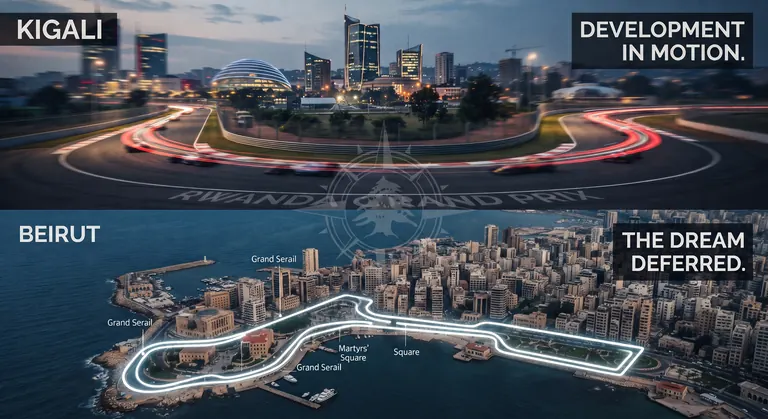
When the news broke that Formula 1 officially signed a historic 10 year agreement to bring the Grand Prix back to Africa, hosting a brand-new race in Rwanda starting in the early 2030s, my mind didn't just drift to Kigali. It flashed back to Beirut and to a man whose grand ambitions were often mocked in his time: the slain former Prime Minister, Rafik Hariri.
Decades ago, during Lebanon’s post war reconstruction era, Hariri envisioned a Formula 1 Grand Prix looping around the Beirut waterfront. Even FIA safety inspectors toured the proposed layout. Back then, local cynics and rival politicians scoffed, mocking the idea as an absurd, out of touch pipe dream for a country trying to rebuild its infrastructure. Hariri was ridiculed for dreaming too big, too fast, on a Mediterranean stage. Yet, looking at Rwanda today, a country executing a multi decade vision to position itself as Africa's premier hub for global tourism, high-profile sports and tech innovation, Hariri's vision doesn’t look foolish anymore. It looks prophetic. It was merely born in the wrong country, surrounded by the wrong ruling class.
Dissection & Economic Analysis: What F1 Inflows Could Have Brought to Beirut
If Beirut had realized that dream and sustained a premier motorsport event over the last two decades, the macroeconomic trajectory of Lebanon could have looked vastly different. Let’s break down the tangible economic inflows an F1 Grand Prix naturally generates:
1. Direct Tourism & Hospitality Inflows
-
The High Yield Tourist: An F1 weekend attracts tens of thousands of wealthy international travelers, corporate sponsors, and global media. Unlike standard summer tourism, F1 tourists spend heavily on luxury hotels, fine dining, high-end nightlife, and retail.
-
The Multiplier Effect: In cities like Singapore, Baku, or Miami, a single Grand Prix weekend injects hundreds of millions of dollars directly into the local service economy, boosting occupancy rates to near 100% and sustaining boutique hotels and restaurants year-round through global media exposure.
2. Infrastructure & Urban Regeneration
-
World-Class Civil Engineering: Hosting F1 forces a city to upgrade its public transport, telecommunications bandwidth, electrical grid stability, and coastal highway engineering.
-
The Waterfront Asset: Hariri’s proposed Beirut Waterfront circuit would have permanently locked in downtown Beirut as a premier Mediterranean hub, accelerating foreign direct investment (FDI) into real estate and commercial ventures rather than leaving prime downtown assets vulnerable to systemic decay and political paralysis.
3. Global Media Value & Soft Power
-
Destination Branding: A live global television audience of 70+ million viewers watching drones and cameras sweep over the Phoenician coast, the mountains, and a vibrant Beirut skyline provides marketing value that no government tourism board could ever buy.
-
Shifting the Narrative: It forces international capital to view Lebanon not as a perpetual warzone or a failed state run by militias, but as a resilient, modern, high-energy capital capable of hosting the world.
The Tragedy of Two Timelines
Look at Rwanda today. President Paul Kagame and his administration recognized that to transcend a dark past, a nation must aggressively invest in its future, secure global partnerships, and build world class infrastructure, such as the massive new Bugesera international airport that I visited and circuit developments tailored to bring jobs, technical skills, and global prestige to its youth. Now look at Lebanon. While Rwanda designs a 10 year horizon with Formula 1, our streets are held hostage by warlords turned mafia bosses who treat the state treasury as their personal piggy bank. While Rwandan youth are empowered to see themselves as engineers, entrepreneur, and global participants, Lebanese youth are forced to pack their bags at the airport, fleeing a collapsing economy engineered by sectarian corruption. Rafik Hariri wanted Beirut to roar with the sound of F1 engines because he understood that a nation dies the moment it stops dreaming. Until we replace the mafia choking our institutions and learn to answer the simple question of identity with a unified "I am Lebanese," we will remain spectators, watching countries that once suffered far more than us race into the future, while we stay parked on the sides of history. (Note: This perspective and analysis are published independently through the Lebanon Institute. The Institute is completely independent, has no links to or financial backing from Rafik Hariri or his estate, and does not endorse specific political figures or parties.)